
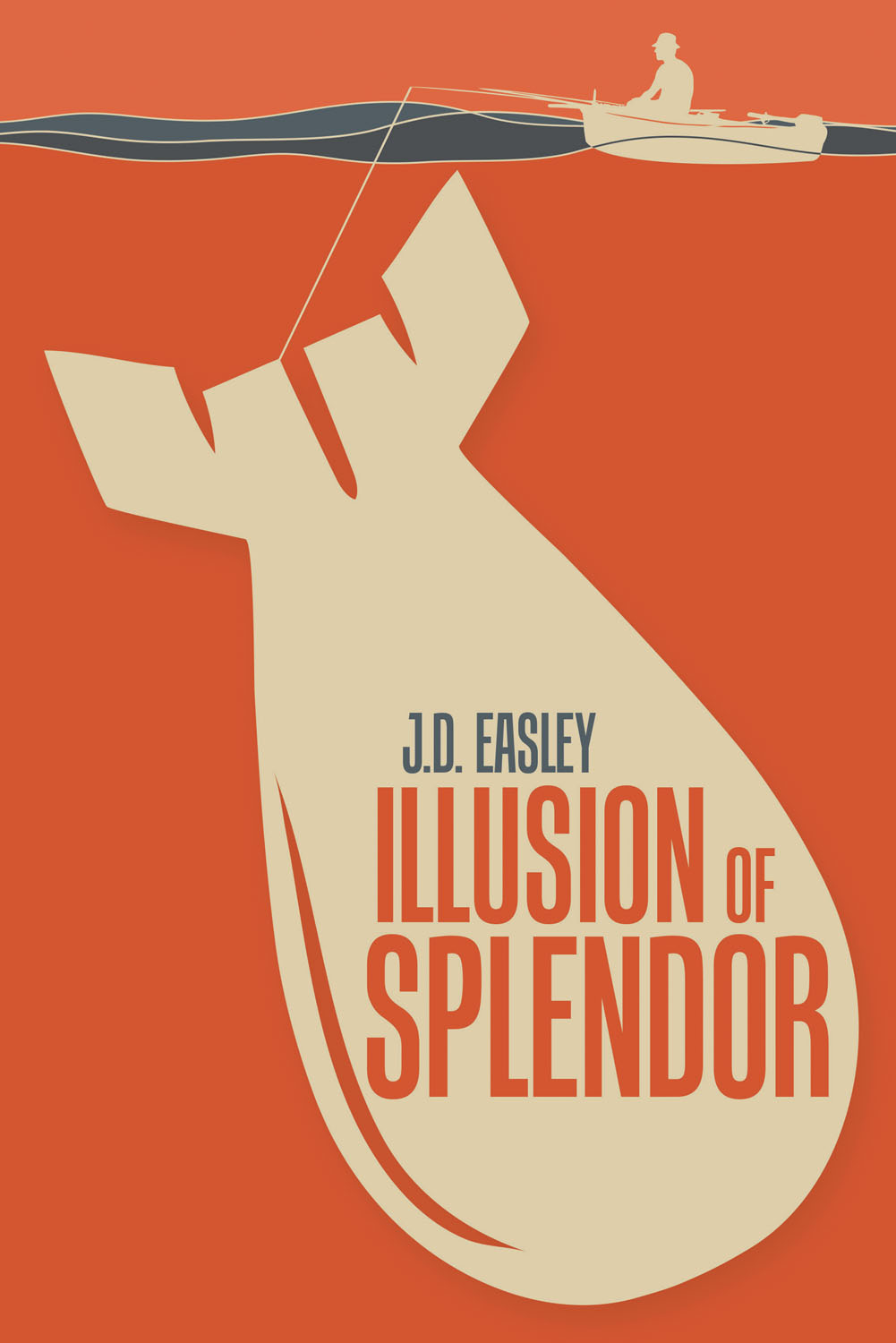
Illusion of Splendor
An International Thriller by J.D. Easley
Waterton Publishing Company
This is a work of fiction. The events described are imaginary and the settings and characters are fictitious and not intended to represent actual places, companies, or persons.
Copyright © 2012 by J.D. Easley. Waterton Publishing Company. All Rights Reserved.
This book, or parts thereof, may not be reproducedin any form without permission.
Published simultaneously worldwide.
Library of Congress Control Number: 2012947104
ISBN: 978-0-9905249-0-8
New chapters to be released (see below). Be the first to receive these by making a $10 donation to the author. We appreciate your gift!
ILLUSION OF SPLENDOR
In Memory of Rain Walsh
1994 – 2011
“Teach us that wealth is not elegance,
that profusion is not magnificence,
that splendor is not beauty.”
Benjamin Disraeli
I REVENGE
On the Atlantic coast of northern Morocco a bearded man wrapped in a long white cotton shawl stands alone on the side of a hill. It is not yet dawn and gazing down into the distance he can barely make out a few dim lights believed to be houses or fishing boats moored in a harbor. He lowers to a rounded boulder and rests a sandaled foot on an adjacent rock and an elbow on a knee, takes a drag from his cigarette, waits, and watches; before long the starless night sky gives way to slate gray with streaks of burgundy highlighting low-hanging clouds. As he waits, the color fades, and so too the windows’ glow as square pale buildings take shape scattered among indistinct date palm and eucalyptus trees. The lone man on the hillside remains motionless, thinking, wishing he had come to this tranquil village for a different reason.
Sawahi is a pastoral community – life passes gradually the way it has for centuries. On this January morning, like most this time of year, a thick layer of clouds hangs over the coast creating a surrealistic haze beyond which palm fronds rustle, roosters crow, and songbirds sing. From out of the mist emerge children on their way to school, shopkeepers on their way to stores, and fishermen on their way to boats. Most of the men make their living casting and trolling in the open ocean from small wooden skiffs with benches and outboard motors and large trawlers with cabins and woven nets draping from poles like heron wings rising from their decks. Others catch their family’s evening meal from a stone breakwater that begins where a boardwalk ends to the north.
Boulders pile adjacent the road for a dozen or so meters until jutting more than fifty meters into the Atlantic as a rampart against the pounding waves. Fishermen jam cork handles of long stout poles into stone crevices; translucent lines dangle from tips, flutter in the breeze, and disappear in ripples below the water’s glassy surface. The sea washes crystal clear over a long stretch of fine white sand beyond the breakwater. After school, children will splash in the surf, run down the beach, chase crabs and pick up empty shells and other objects deposited by the retreating breakers. Later, some of the villagers may build fires in stone pits sheltered by post and thatch huts.
Hills and ravines enclose the village on three sides so it remains an isolated oasis of white on a green and blue background from which just one narrow dusty spur accesses paved thoroughfares many kilometers distant and, eventually, highways, towns, and cities such as Tangier and Casablanca. There are few visitors to the village. Most are vendors bringing food, water, and dry goods by truck to resupply local merchants; tourists from the south fishing for perch, billfish, and tuna; families arriving by car or boat to meet friends or relatives; or passengers on vessels bound elsewhere in Morocco, across the Atlantic to Spain or Portugal, or through the Strait to countries of the Mediterranean.
It took Alwar almost three days to reach the dirt road and hillside overlooking Sawahi from his home in Libreville, Gabon. Driving through Cameroon, Nigeria, Niger, Algeria, and most of Morocco, he traveled as early as possible to avoid the midday heat but never early enough it seemed to avoid the congestion of people and livestock plodding the rural thoroughfares. His life-changing journey began with a simple instruction delivered by a red-haired American wearing round tortoise shell glasses, a white short-sleeve shirt stained gray around the armpits, and a bright yellow tie. The out-of-place foreigner pretended to be in the market for sea bass while making his way around the docks in Libreville. Eventually, he stopped at Alwar’s small sailboat, the Jubilet.
The American stooped down, picked a fresh anchovy out of a bucket on the dock, and whispered to Alwar that he must sail the next day to a point a kilometer or so off the coast where the Gulf of Guinea meets the Gabon Estuary. There, at the periphery of a prominent sandbar well known in the area for very poor fishing, he would meet with a British Secret Intelligence Service officer from Port-Gentile. “Sail out by no later than six-thirty” advised the American, “then drop anchor, cast a fishing line and wait until at least eight for Michael Crane to arrive.” He handed Alwar a dollar bill and Alwar wrapped the tiny fish in newspaper.
Jubilet’s anchor plunged through kelp near the sandbar and a red warning buoy early the next morning. The weather was perfect; warm, clear but for a few white wisps, just a slight southerly breeze. Upright on deck, Alwar soon spotted what he believed to be a cabin cruiser motoring from the east. The vessel appeared and disappeared under the sun and swell as he tried with difficulty to keep track of its whereabouts through binocular lenses shielded by polarized sunglass. When the boat became larger than the waves, Alwar could see that it was navigating a steady course toward him and, when it was ten or so meters away, a nameless red and yellow wooden cabin cruiser slowed and a dark boy wearing a Red Sox cap hung two white bumpers over the side.
“Alwar!” the boy’s overly-enthusiastic loud greeting apparently a misguided attempt to mislead eavesdroppers – despite there being no other boats within view – followed more reserved by the boy asking if he was indeed addressing Alwar: “Êtes-vous Alwar; comment allez-vous?”
“Bien, oui, mon nom est Alwar, êtes-vous?” Cautious was the tone of Alwar’s welcome as he dropped the sponge grip of a black fishing rod into a steel tube bolted to the hull. Line ran taught from the pole tip to the water’s surface as the Jubilet rocked casually side to side with a squid tentacle enveloping a hook less than a meter under keel.
“Je suis bon;” answered the boy, “monsieur Crane est ici!”
Alwar silently examined the boy wondering why he had not asked if Alwar was alone, and, after a few seconds, twisted, leaned far over the side of the Jubilet and rubbed the palms of his hands briskly in seawater to hide the residue and smell of squid should Michael Crane wish to shake his hand. Once again standing, Alwar shook his hands, reached down to retrieve a dirty blue towel from the deck, dried, dropped the towel on a nearby bench, turned both palms up, and shrugged his shoulders in an obvious quizzical gesture to the boy. The boy’s muted response was simply to stand straight with feet apart, gaze at Alwar with eyes wide, and point in the direction of the yellow cabin.
The red and yellow cruiser drifted and recoiled as the two foam bumpers grinded and squeaked between the chipped paint of sealed hardwood slats. Alwar took a bow line tossed by the boy and looped it around a cleat, lifted the vinyl cushion of a bench in the back of the Jubilet, and removed binoculars. Walking along the railing he studied the horizon, vigilantly circling the deck twice searching for any sign of a possible intruder, anybody, in a position to see the two boats.
“It’s okay, there is only one boat and it is at least two kilometers away” proclaimed Alwar while pointing to the north.
In one leap the boy stood atop the yellow cabin, eyes shaded with his right hand he squinted and focused on the distant north, rotating his head very deliberately as the tiny outline of what appeared to be a fishing trawler popped in and out of view. He knelt and pounded on top of the cabin, “Il est vrai, monsieur Crane, il n’y a qu’un seul bateau.”
The old teak door of the small cabin creaked and soon a dark brown head appeared followed by chiseled hands grasping both sides of the doorframe. Michael Crane ascended cautiously from the cramped compartment; a lean and tall man, at least one hundred ninety-five centimeters, he crouched low, bending at the neck and waist to clear the top of the entry and twisting in obvious pain to straighten. His right hand held the brim of a tan straw hat supporting a red and blue rolled bandana, his left, a pair of gold wire aviator sunglasses.
Michael Crane was born Chiwetel Otaphi in a small Nigerian oil town where the bathwater smelled of tar and gas fumes flared night and day. His father died in a rig explosion when Michael was five, and he and his mother moved to Lagos, where she found a job washing dishes in a Mediterranean restaurant. Michael spent days in the streets running with the other children and nights in the restaurant playing with the owner’s son, eating kabobs, listening to Persian music, and watching scantily-clad belly dancers writhe through dimly lit tables.
When Michael was eight, his mother contracted malaria while visiting his father’s gravesite near the oil field, and was bed-ridden for nine weeks before dying. The owner of the Mediterranean restaurant took Michael in, but there was very little space in their two-room apartment – with six other people – and he left after three weeks. Michael wandered the streets of Lagos for nine months, surviving on handouts from the restaurant and sleeping under a bridge on Ozumba Mbadiwe Street near the bay. Sisters from the Streets of Eternity Orphanage found Michael digging in a trash pile one sweltering August night and he spent the next two-and-a-half years studying Catholicism and speaking English.
A British schoolteacher and his wife, volunteers at the orphanage, adopted Michael when he was eleven and moved him to their house in central London. There, he attended parochial school, played football on the school team, and fell in love with a blonde violinist. She moved away with her family to Paris when Michael was seventeen and, in an act born of remorse, he enlisted in the Royal Air Force by convincing the recruiter he was eighteen. Michael learned young how to shoot and parachute from airplanes and kill people in close quarters using knives, small arms, and guerilla tactics; he wanted to be a pilot but his height made the cockpits of smaller jets confining and a football injury to the left ear had caused an almost total loss of hearing. So instead, he became a soldier, a very good soldier.
Michael served two tours in the Bosnian War operating radar aboard troop transport planes. During one campaign in early 1993, while flying in a blinding snowstorm, his plane made an emergency landing near a village in Eastern Bosnia and he wandered the town and saw the snow-enshroud graves of Muslim men, women, and children killed by Serb forces. A woman appearing about forty approached Michael and tried to talk with him in Bosnian. He responded in French and English. The woman understood when Michael said in English that he too was a follower of Islam and she bent down, raised her billowing black skirt, and showed him deep purple scars around both ankles.
Michael applied with the British Secret Intelligent Service, MI6, after the war, became an Intelligence Officer, and was, after training and taking first in his class, assigned to a Lagos field office. It was 1995 and his cover was a cacao and palm oil export company on a noisy Victoria Island side street next to a sewage canal. Michael spent days monitoring monotonous telephone communications, following local news reports of questionable veracity, and conducting generally meaningless surveillance, and evenings in the Peacock Café across from the Radisson Hotel, plying locals with dirty gin martinis and befriending bartenders and prostitutes.
Members of the Alliance for Democracy broke into Michael’s office in March 1998, in a well-planned effort to discover the names of companies buying palm oil – to organize a boycott – and stumbled upon a file at the bottom of an unlocked wooden cabinet. Pinned to the cover was a photograph of Michael in his RAF uniform; inside were other photographs of Michael, papers on RAF letterhead, and a handwritten note from Air Marshal Peter H. Wiggens. One of the burglars later told a friend about the file during a birthday party on a sightseeing ferry in Lagos Harbor.
The following week, on an overcast Wednesday mid-afternoon, two black men in khaki pants and bright dashiki shirts appeared at the export company entrance. They glanced up inconspicuously searching for security cameras and, finding none, the taller man casually rang the buzzer. Michael’s partner, Kender Frederickson, set down his teacup, rose from a chair behind his desk in the front office, descended one flight of tattered carpet stairs and peeked out through the wrought iron bars of a very small one-way glass window encased in double-ply laminated and sealed iroko wood.
“Who is it?” he inquired in a loud voice.
One of the men, the shorter of the two, responded “Hello! My friend and I, we have a palm plantation in Kenya. We are looking for someone to sell our oil.”
Kender studied the men through the small window, his eyes moving slowly up and down each, darting from the shorter man to the taller man and back again; he surveyed the men to make out the style of shoes and looked closely for signs of nervousness or any bulges in the shirts.
“Please step back away from the door” Kender requested, demanded, again in a loud voice and one clearly conveying suspicion. The men stepped backward in unison and Kender could see that both wore clean, probably brand new, Adidas or Nike running shoes.
“I’m sorry” Kender said, again loudly, even more resolute, “we’re not taking any new orders at this time. Why don’t you try a block down on the other side of the road, the Pyramid Trading Company? By the way, how did you hear about us?”
The same man, the shorter, responded “Okay, thank you, yes, we will,” but neither man answered Kender’s second question.
The two suspicious visitors turned their backs to the door. Kender leaned closer to the window, his nose pushed against the glass, watching curiously as the men scrutinized both directions up and down the street until walking briskly between passing cars in the direction of the Pyramid Trading Company. The orange and blue rubber soles of their shoes began flashing fast, and faster, becoming smaller and smaller as the men sprinted out of view.
Kender turned from the door. His mind was racing, something was wrong, but what? Wanting quickly to compare what he remembered of the men, faces, sizes, clothes, voices, with those in a database, wanting hastily to file a report and telephone the Pyramid Trading Company and warn Michael their cover was blown, he started to move. “Wait, but I’m safe inside” he thought, nothing happened, maybe there was no danger, maybe the visitors were indeed just selling palm oil.
As happens in the end, control relinquished to circumstance. Everything around Kender seemed to slow down; legs became paralyzed, unable to respond to commands, comprehend the exigency – the top of the stairs, his desk, so far away. A left foot settles upon the damp fibers of a stair, a right hand touches the smeared paint of a handrail, and a splintered remnant severs the quadriceps of a right leg; life smothered, family, friends, irrevocably damaged, all by a small package wrapped in a white cloth once lying at the foot of an impenetrable door.
Michael was at that terrible instant upstairs in the back office. The bomb shivered the concrete building, shattering windows, tossing him like a ragdoll from his chair behind a steel desk. Michael’s head slammed the concrete wall and he blacked-out briefly, and, in a daze, found that he lie propped against the wall under holes where a few minutes ago were windows. His body was torn and twisted, arms dangled, legs crumpled. It felt like a dream. Moving his arms, legs, one at a time, just a little, bending at the joints, Michael tried to leverage his elbows against the floor for support but felt stabbing pain. He slumped, and felt the warm fluid streaming down his forearms, pooling in shards and slivers of glass.
“Kender?” there was no response to Michael’s faint plea; “Kender, are you OK?” he knew the answer, “Kender!”