
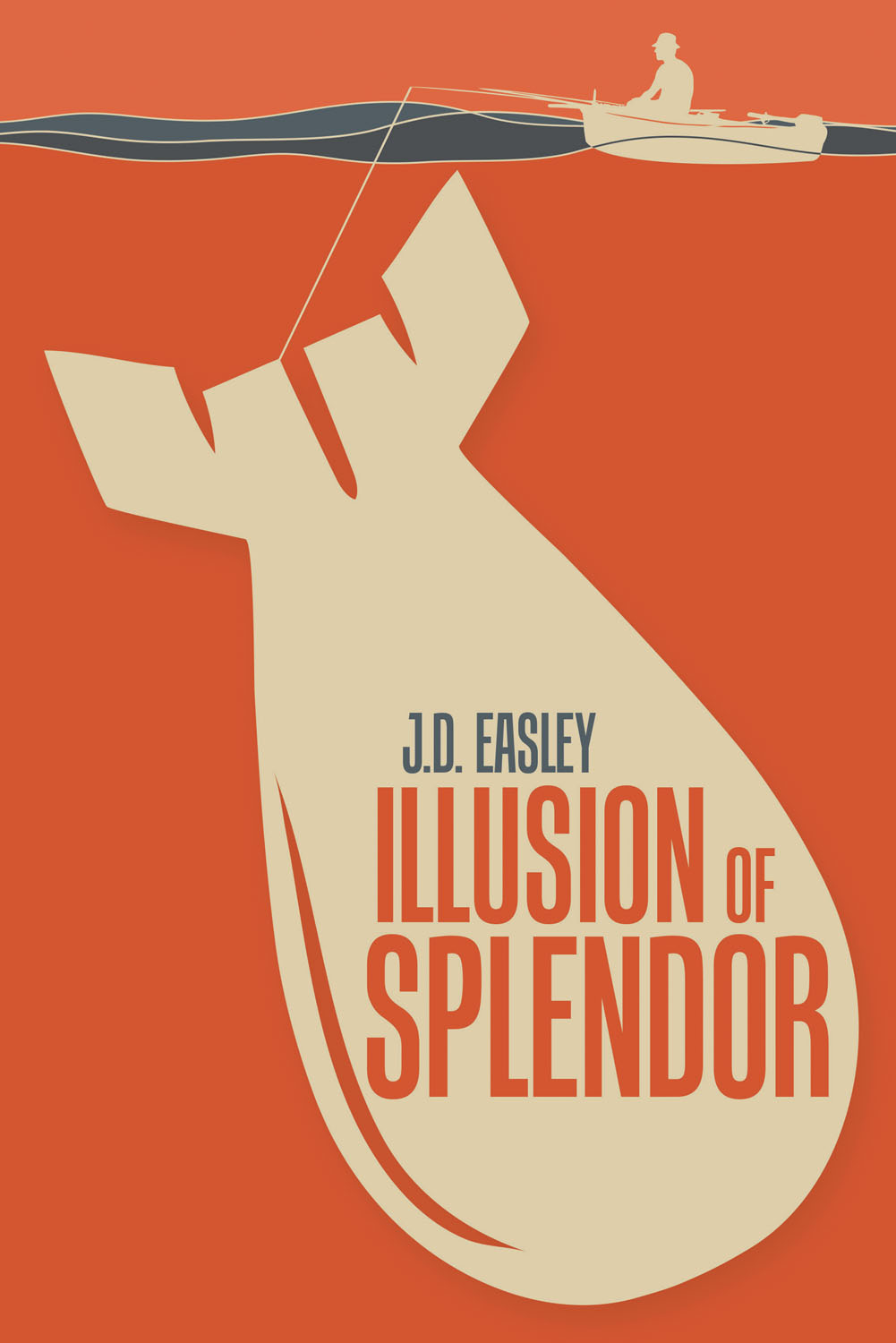
Illusion of Splendor
An International Thriller by J.D. Easley
Waterton Publishing Company
This is a work of fiction. The events described are imaginary and the settings and characters are fictitious and not intended to represent actual places, companies, or persons.
Copyright © 2012 by J.D. Easley. Waterton Publishing Company. All Rights Reserved.
This book, or parts thereof, may not be reproducedin any form without permission.
Published simultaneously worldwide.
Library of Congress Control Number: 2012947104
ISBN: 978-0-9905249-0-8
New chapters to be released (see below). Be the first to receive these by making a $10 donation to the author. We appreciate your gift!
ILLUSION OF SPLENDOR
I REVENGE
Michael spent three days in Lagos General Hospital for a concussion, ruptured cervical disc, and lacerations on his arms and back. On the fourth day an MI6 section chief in Libreville chartered a Cessna, flew to Lagos, took a taxi to the hospital, and escorted Michael from the hospital back to Gabon. After a week in Libreville, recovering and awaiting his new assignment, Michael received word to report to an outpost in Freetown, Sierra Leone, and assume the title Head of Operations. It was January 1999.
Over the next four years Michael Crane directed security service operations for Sierra Leone, Guinea, Guinea-Bissau, and Liberia; his officers infiltrated low-level rebel factions and helped Liberians United for Reconciliation and Democracy in their battle to dethrone President Charles Taylor. Michael rarely took direct part in covert operations, however, because of constant pain in his neck and numbness and tingling in his right arm. He was also addicted to fentanyl, injecting the potent narcotic in his numb right arm twice a day, and double-shot Bacardi dark rum and espresso cocktails, which he imbibed every afternoon at a vibrant outdoor café overlooking Susan’s Bay.
It was at this café two months after arriving in Freetown that Michael arranged for the assassination of the men responsible for Kender Frederickson’s death. He learned their identities while hospitalized in Lagos, after paying a private operative five-hundred dollars. The operative made contact with a young fruit-cart vendor, Alliance for Democracy junior officer, occasional paid informant for Western intelligence services.
The informant agreed to reveal the bombers’ names only after being paid, told the reason, and on condition that the operative’s principal make the request in person. Following some finagling the operative late one night escorted the fruit vendor to Michael’s hospital room where the prospective informant handed Michael his five hundred dollars and agreed to provide the names in exchange for a “promise you will remember me.” Michael promised.
After settling in Freetown, Michael called a friend in Frankfurt, Klaus Adalbrecht, a “specialist” under occasional contract with MI6 and the CIA. Klaus boarded a flight to Freetown the next day. Michael met Klaus at Lungi International, drove him to the café, and slipped a two-thousand Euros deposit – cash from a special fund – under a napkin.
It was a sunny day, clearer than usual and not too humid, and the two sat outside at a table closest to the railing next to banana trees and a shack so as to admire the bay. Klaus discreetly slid the white napkin from the table, crumpled it in his hand to conceal the bills, transferred the napkin to his lap, removed the money with his right hand and with the other removed a nylon pouch held by a belt under his pants and stuffed the money into the pouch. He and Michael spent the next hour drinking double gin and tonics and laughing as each recalled lighter moments during training for the foreign intelligence services.
As fond memories faded, and laughter ebbed, Michael leaned forward after having surreptitiously surveyed the patio; smile gone, voice hushed, he stared intensely at Klaus until revealing something that had for weeks inside him percolated rage: “Kender bled to death in pieces.” Michael wanted to say more but choked upon hearing the words; holding back tears long overdue he at last blurted, “I want these bastards exterminated.” The word lingered as somehow improper – even evil – an uncomfortable violence daring to disturb tranquility.
“That’s what you paid me to do, Michael,” Klaus replied in compelled casualness too late. Wanting to release the tension and ease Michael’s discomfort, Klaus uncrossed his legs and shuffled to the edge of the chair, crossed his forearms on the tabletop, looked into Michael’s eyes, and explained serenely, “It is what I am trained to do, you know, exterminate,” followed up by a long sip of gin and tonic.
“Yes.” Michael paused, looked down at the table and up at Klaus, “I have the package for you; it’s in the trunk of the Ford, everything you asked for. Contact me with your expenses, the usual, Midland and Brookfield, if you get in a pinch, and I’ll arrange payment to your Cayman account.”
“That’s fine;” Klaus took a sip, “how do you want confirmation?”
“Your word is good with me Klaus, but if you can get a photo without risk, that would be great. I’d like to see….” Michael did not finish the sentence. This was not about prevention; it was about vengeance, pure and simple, revenge.
Klaus understood; “I’m sure an image will be no problem.”
“Your flight is at seven-thirty, I suppose we should get going.” The two men raised their drinking glasses dripping condensation in an unspoken, understood toast; ice cubes rattling, they took one last long drink, pushed back their chairs, and stood. Michael went to meet the waiter as Klaus stayed behind, hands in his pockets, contemplating the bay and the shanties lining the hillside. “What a picturesque slum” he thought, and slowly walked to a path leading from the patio through a grove of mango and banana trees to a dirt parking area. Michael joined him and they strolled without speaking to the Ford.
Michael arranged for Klaus to hitch a US Army cargo plane from Freetown to Lagos and drove past the Lungi International terminal along a chain-link fence half a kilometer to a closed gate. A large sign mounted on a pole at the center of the gate cautioned passersby, in English and French, against stopping or loitering. Behind the gate, two Military Police Corp officers with M4 carbines stood a silent vigil.
Holding his left arm straight out the window, consular identification card in hand, Michael slowed the car to a stop. The gate barely opened and an MP squeezed through and carefully approached the car with both hands on a carbine low and to the side. The other MP stood behind the gate, carbine low and center, finger on the trigger. Klaus placed his hands on top of the dash and cocked his head for a view out the driver’s window.
Michael spoke first: “Michael Crane, British intelligence, with a passenger for the seven-thirty transport to Lagos, cleared by Colonel Firston.” The MP lowered his chin to the left and whispered into his collar; remaining focused on Michael and Klaus he reached and took hold of the identification card, stepped back, and studied the card. After several minutes he lowered the carbine and walked back to the car, handed Michael his card, and said “You’re clear, stop at the hangar” while the gate swung open.
Michael drove a short distance down the dusty road, turned right, and proceeded until passing through gaping sliding doors into a cavernous metal hangar empty but for a few pallets loaded with cardboard boxes. He and Klaus stepped out of the Ford, lingered for a moment surveying the vast structure, and walked out into the sunlight toward a dark green C-12 Huron sitting on the runway. A gray-haired man in fatigues stood in an open rear door of the airplane. He waived at Michael and Klaus as they approached, disappeared, reappeared in a door toward the nose of the plane, and quickly descended a rolling staircase to meet them.
“You must be Michael Crane,” the man looked directly at Michael, obviously aware that he was Nigerian, and in a friendly voice approached and held out his hand, “I’m Johnny Firston.”
“Colonel,” Michael grasped the Colonel’s hand, “it’s a pleasure, this is Klaus Adalbrecht,” and nodded toward Klaus who reached out with his right hand.
“Good to meet you, Klaus, you ready for a ride?”
“Yes sir,” replied Klaus with his German accent and confident smile, “as long as the stewardess is serving cocktails.”
“I’ll get the rest of your things, Klaus,” exclaimed Michael, turned, and jogged to the hangar; after unlocking the Ford trunk he delicately pulled out a black satchel and black canvas scuba duffel, slipped his right hand through the strap of each, hung the bags from his shoulder, walked briskly back and handed them to Klaus. The men talked a few minutes longer and said goodbye. Klaus and the Colonel ascended the stairs as Michael leisurely returned to the hangar.
About three and a half hours later, Colonel Firston drove Klaus to a hotel in upscale Ikoyi on Lagos Island. Klaus did not necessarily want the attention of riding in an Army M1117 Armored Security Vehicle, but no other transportation was available from the isolated corner of Murtala Muhammad International Airport where the C-12 landed and, if dropped at the airport taxi stand, cab drivers would suspect he was with the United States military. He figured cab drivers were infinitely more talkative and troublesome than bellmen.