
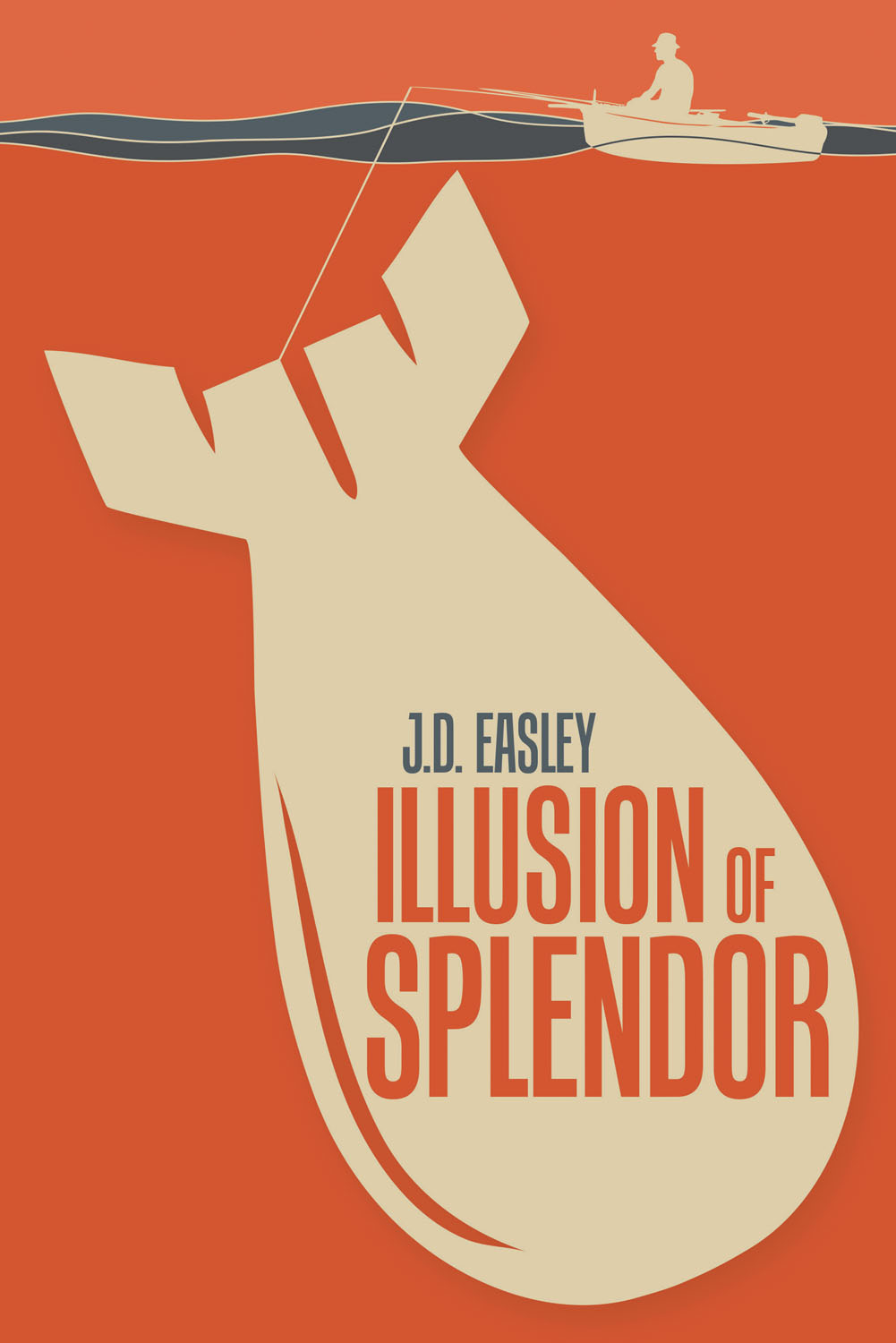
Illusion of Splendor
An International Thriller by J.D. Easley
Waterton Publishing Company
No part of this book was created using Artificial Intelligence (AI).
This is a work of fiction. The events described are imaginary and the settings and characters are fictitious and not intended to represent actual places, companies, or persons.
Copyright © 2012 by J.D. Easley. Waterton Publishing Company. All Rights Reserved.
This book, or parts thereof, may not be reproducedin any form without permission.
Published simultaneously worldwide.
Library of Congress Control Number: 2012947104
ISBN: 978-0-9905249-0-8
New chapters to be released (see below). Be the first to receive these by making a $10 donation to the author. We appreciate your gift!
ILLUSION OF SPLENDOR
II PRIVACY
Robert Downing lowered his head while appearing to reflectively fixate on the light gray speckled vinyl tile floor, hands in dark gray wool trouser pockets, jacket unbuttoned, pacing in front of and under a ten by seven foot photograph of a surveillance camera mounted on a pole directly below a billowing American flag. He stopped, turned, took two steps toward the bleachers filled with students, raised his head, gazed at the back row far above where he stood and spoke in a low voice.
“What is privacy?” a rhetorical question he nevertheless hesitated.
“Is it an act born of free will, or is it the existence of a condition, or both?” Professor Downing paused again. “If you want privacy, how do you achieve it – by sitting in the very back?” A short burst of laughter from the audience, to the speaker signifying at least some attentiveness.
“What if somebody, or something, invades your privacy, as I am doing now?” – cutting short another burst: “How do you protect your privacy, are there privacy laws, are there privacy police?”
The professor gazed around the room at wide-eyed closed-mouth faces staring at him and the photograph of a flag-enshroud camera.
He glanced down again and scanned the front row, speaking authoritatively, “The concept of privacy is not easy to comprehend, and it is what we are going to spend the rest of today’s class, as well as the short remainder of the term discussing. It clearly means more than just the opposite of publicity. In its most basic form, seclusion, privacy at some level is an absolute necessity for every living thing.
“Conceived through both conscious rationalization and unconscious behavior, rising to the level of instinct, privacy is the initial and easiest method of protecting the individual and the family. The concept of privacy relates to those of personality and vulnerability. To reveal the private is to accept the consequences of vulnerability.”
The background image slowly transformed into a brown and white wolf, beautiful blue eyes focused keenly on the class, two small puppies huddled under her taught frame. All that could be heard from the audience was the isolated crackle and squeak of chairs.
Professor Downing’s voice projected louder as he moved to the podium and lectured into the microphone: “Privacy is a fundamental human need, indeed, a need for all living things, and at some level, a matter of survival. In a cave surrounded by enemies, or predators, the location of food, the number, gender, and routine of inhabitants, these were facts undoubtedly kept secret as a matter of life and death.”
He briefly stopped, looked up, and back down. “The same was undoubtedly later true in a hut, in a house, or in a castle. No authority had any right conferred by society at large to invade this right of privacy when survival was at issue.
“How do we reconcile privacy and survival with what the American writer Ayn Rand observed” queried Professor Downing to his students, “that ‘Civilization is the progress toward a society of privacy. The savage’s noble existence is public, ruled by the laws of the tribe. Civilization is the process of setting man free from men.’?”
The professor looked up, slipped off his frameless reading glasses – more for comfort and show than necessity – and held them in his right hand above the podium. He surveyed the entire class. “Do you believe privacy has been with us since the cave – that we as a society are losing our privacy; and, if we are indeed losing our privacy, are we becoming more or less civilized? Is Ayn Rand correct, that we are moving toward a society of privacy and therefore becoming more civilized?”
“Losing it!” a young man bellowed from the side of the room.
“Okay…” Professor Downing reacted, thereafter pausing to focus on all of his students, “does that mean we are becoming less civilized or more civilized?”
Just a few arms jutted above the crowd of faces and the professor pointed to one on the other side of the room; the hand lowered and a young woman raised a voice, “We are becoming more civilized.”
“Why?”
“Because nobody can do anything uncivilized if they don’t have any privacy!” A wave of faces turned to look at the woman and broke into smiles; Professor Downing smiled too, and considered the woman as she smiled in return, waiting for him to affirm the validity of her answer.
“And you are?” he asked as a prelude to looking down, fumbling with a roster, and pressing his right index finger on the bridge of his glasses.
“Rain Walker,” the woman responded somewhat less confidently, “My name is Rain.”
“Well, Rain, you have touched both sharp edges of the sword I’m afraid,” Professor Downing slipped off his glasses, glanced at Rain, and addressed the audience, “because privacy is essential to each of us while it is, in practice, a hindrance to civilized society. The question is, just because we are becoming more technologically advanced, and are applying that technology to protect our society, are we also then becoming more civilized?”
“Rain?” the professor called and in response the young woman clasped her hands and leaned forward against her desk for security, “Well, I don’t think so; it isn’t really very civil to spy on one another.”
“So, we are in fact becoming less civilized in an Orwellian attempt to provide security for our citizens;” the professor was standing next to the podium holding his glasses, “as we forsake privacy for security, we move back to a less civilized society, do you agree?” He examined the classroom full of people as the question hung in the air, “…And if this is true, that we are becoming less civilized, than aren’t we in fact in more need of privacy, to protect ourselves and our families?”
The room was silent as young heads harboring minds enlightened or bewildered followed the instructor in front of the podium and under the grand image of the protective wolf mother guarding her young puppies.
He broke the silence, “If we are losing our privacy it is because it is being taken away from us, isn’t that correct, by our government and our institutions! We as a society are sacrificing our privacy in the hope our government and institutions will protect us. Protection has become more important than civility. Now, doesn’t that open just a huge can of worms?” and glanced around the room.
“Aren’t we really turning over control of our lives to our government and our institutions – hoping that they are guided by our best interests?”
Professor Downing took another break to consider the audience, turned, moved slowly to the podium, pushed his glasses into place and crumpled his notes. “Is this civility? Let me read the quote from Ayn Rand again: ‘Civilization is the progress toward a society of privacy. The savage’s noble existence is public, ruled by the laws of the tribe. Civilization is the process of setting man free from men.’ Rand doesn’t seem to address the issue of setting people free from politicians and the people that make up governments.
“Let’s see a show of hands; how many of you think Rand is right and that civilization is progress toward a society of privacy?” A few arms rose at first slow and cautious followed by those from others at first uncertain until there appeared a field of hands all sizes and colors.
“Okay; how many of you think Rand is wrong and that civilization is really progress away from a society of privacy and toward a public existence governed by laws?” The professor watched the students beginning at the wall to his left; just a few hands lifted hesitantly.
“Hmm, so most of you believe we are moving away from civility, or I suppose you may believe we are progressing toward a society of privacy and therefore civility.
“Let’s see which it is.” Professor Downing focused on the center of the class and removed his reading glasses, “Just those of you who raised your hands because you believe Ayn Rand correct, how many of you believe we are progressing toward a society of privacy?” He kept his head still and moved only his eyes, looking for reaction, but there was none.
“Now, everyone, how many believe we are progressing toward a society of privacy?” The students were still, not an arm in the air.
“And this is probably true of our society as a whole” he pronounced confidently into the microphone, “we do not believe our society is progressing toward privacy, we believe our society is progressing away from privacy.”
“Let’s draw some conclusions” lectured the professor, glasses low on his nose, reading from his notes, speaking methodically, glancing at the class above lenses between sentences, “based upon the fact we elect our representatives. First, the majority of our society now must believe security is more important than civility. Second, the majority of our society must trust our government and institutions, such as corporations. Third, these two conclusions lead to the inescapable conclusion that we, as a society, are willingly turning over control of our private lives to governments and institutions. And, fourth, if we as a society do not believe security is more important than civility, or if we do not trust our government or institutions, as a society, than we have lost control of our lives because we have lost control of our privacy.”