
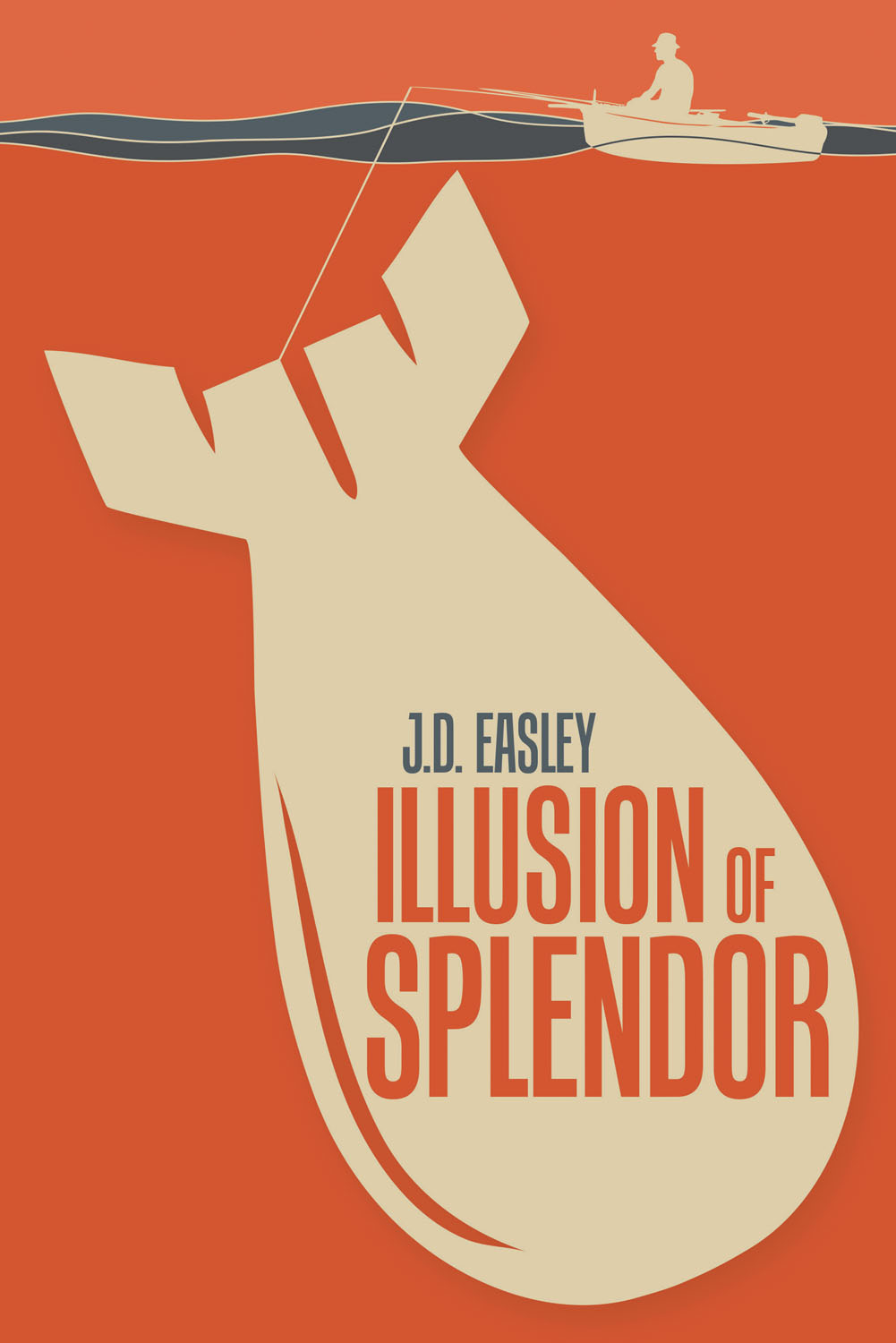
Illusion of Splendor
An International Thriller by J.D. Easley
Waterton Publishing Company
No part of this book was created using Artificial Intelligence (AI).
This is a work of fiction. The events described are imaginary and the settings and characters are fictitious and not intended to represent actual places, companies, or persons.
Copyright © 2012 by J.D. Easley. Waterton Publishing Company. All Rights Reserved.
This book, or parts thereof, may not be reproducedin any form without permission.
Published simultaneously worldwide.
Library of Congress Control Number: 2012947104
ISBN: 978-0-9905249-0-8
New chapters to be released (see below). Be the first to receive these by making a $10 donation to the author. We appreciate your gift!
ILLUSION OF SPLENDOR
II PRIVACY
Professor Downing lowered his head and spoke softly into the microphone. “I will tell you that I believe, as a society, we do want security more than civility, for reasons we shall discuss later, and we do not trust our government or institutions, and, therefore, we have lost control of our individual privacy, our individuality, our independence.”
After allowing a moment for the class to absorb and reflect on his opinion, the professor lifted his head and changed tone. “These are the questions we will examine during the remainder of this class and next class. When and why did America choose security over civility; when and why did we, as a society, as a people, lose control of our private lives; and has our country slid irrevocably past the peak of civility so that we are now regressing as a civilization.”
Many of the students glanced at their phones or the wall clock, thinking the class time over, as Professor Downing might have expected using time itself to reposition his reading glasses and review his notes.
With ten minutes left he went back to the microphone – in obvious dismay to some in attendance – postulating that “Privacy is still quite often the only bulwark against vulnerability, some of which may result in serious injury or death, depravation of freedom, or financial ruin. This is why its erosion, as a matter of public policy, has always been hard-fought; a balance struck between the individual’s need for privacy and society’s need to know the facts. In truth, however, it is never society which purports a need to know sufficient to supplant the individual’s right to privacy.”
The wolf and her pups became a large man wearing a uniform leaning down with his hands on the sides of a young girl, a child, patting her clothing – the scene obviously an airport security checkpoint.
A sense of unease descended on the room.
“It is government,” he looked over his reading glasses directly at the students in the front row, paused, and looked down at the lectern, “government made up of people, people made up of objectives, objectives sometimes contrary to those of society, whether society knows it or not.”
Professor Downing continued looking down at his notes, careful not to look up, to see the inquisitive faces and to hear the question – are you saying our government is corrupt?
“Privacy is an important component of individualism and independence; privacy from government oversight is liberty in its rawest form, freedom from government intrusion and, therefore, oppression, the freedom to carry on human activities without government knowledge or interference; privacy is the foundation of a democratic society, of a people free to elect their representatives without fear of reprisal; privacy is the essence of individualism bestowing upon each person the opportunity to make free choices and exercise free will; privacy is the hallmark of independent thought and independent action,” his eyes moved to each of the students and he continued very slowly, “private thoughts…enable private decisions…that promote private action.”
Professor Downing stopped speaking, glanced at the wall clock, and turned his head to study the image. A little blonde girl larger than life, holding open the lapels of her red wool coat by her tiny hands to expose only a white sweater with embroidered blue and red flowers; beside her, a large smiling man wearing a government uniform, representative of the most powerful, certainly one of the most civilized, societies the world has ever known, a stranger to this child, inspecting her clothing for a bomb. America feared this little girl wantonly or maybe unknowingly capable of causing the destruction of a commercial airliner and the lives of hundreds of people and the professor hoped – in silence – that what he found to be an irony would not be lost entirely on his students, that some aghast at the image may wonder in stunned introspection if their country had not lost perspective.
After some time, perhaps a time too long, in perhaps only a thinly veiled attempt to reinforce and promote his belief in the erosion of the right of personal privacy, the professor spoke softly into the microphone: “Ayn Rand said, the savage’s noble existence is public, ruled by the laws of the tribe. Is this child a savage? Are we the tribe? Are we moving toward civility or toward security; are the two mutually exclusive?”
A waving hand in the middle of the second row caught Professor Downing’s attention and he removed his glasses and pointed at the student. A young man lowered his hand and exclaimed quite certainly that “I, for one, would rather give up some privacy in exchange for safety, what’s the alternative if terrorists are blowing up airplanes; you have to search people one way or another!”
Professor Downing nodded while looking at the roster, “You…must be,” using his right index finger he counted seats from his right, “Cindy!” There was an eruption of laughter and the young man smiled bashfully and replied, “No, sorry, she’s back where I usually sit, we traded places so she could sit with her boyfriend today, um, my name’s Frank.”
The professor expressed a slanted smile clearly signifying “What’s the point of a seating chart…,” glanced at his notes and responded, “So now Frank, we are back to Rain’s double-edge sword, as well as the issue of consent. There is no doubt that privacy hinders a civilized legal system in pursuit of individual justice that depends for its legitimacy on an accurate discernment of the facts. Otherwise, the innocent are prosecuted and the guilty escape punishment. Absolute privacy is effectively a bar to absolute justice, without an accurate factual foundation law has no relevance and justice no application.
“What Frank is saying, I believe,” Professor Downing took off his glasses and rotated again to review the PowerPoint image, “is that there has to be a balance between protecting the individual’s privacy, by calling it a ‘right,’ and protecting society at large.”
Returning his stance toward the audience, “Privacy is the first line of defense against vulnerability and therefore harm; publicity subjects us to potential harm from individuals and organizations. Disclosing information you hold private to people you don’t know is fraught with danger. If you have to make such disclosure, for example to buy something online, the legal system is supposed to afford a second line of defense. If the legal system is ineffective, if there is no law or no immediate enforcement, privacy becomes more important than convenience. This goes back to our institutions and trust.
“Privacy invokes thorny issues. Reasonable expectation is the lynchpin of protected privacy in almost all judicial analysis, this evaluation intended objective, narrowed ever so precisely for the situation in which the unfortunate proponent finds his or herself. We have a reasonable expectation over our bodies while in the home, in the office, in a car, in a phone booth, walking down the sidewalk, and crossing the street. Whether our expectations are protected is a different matter altogether; the reasonableness standard inevitably produces hard and fast rules tossed out ever so readily by a judge exercising subjective reasoning. Is the murkiness of privacy clear yet?”